
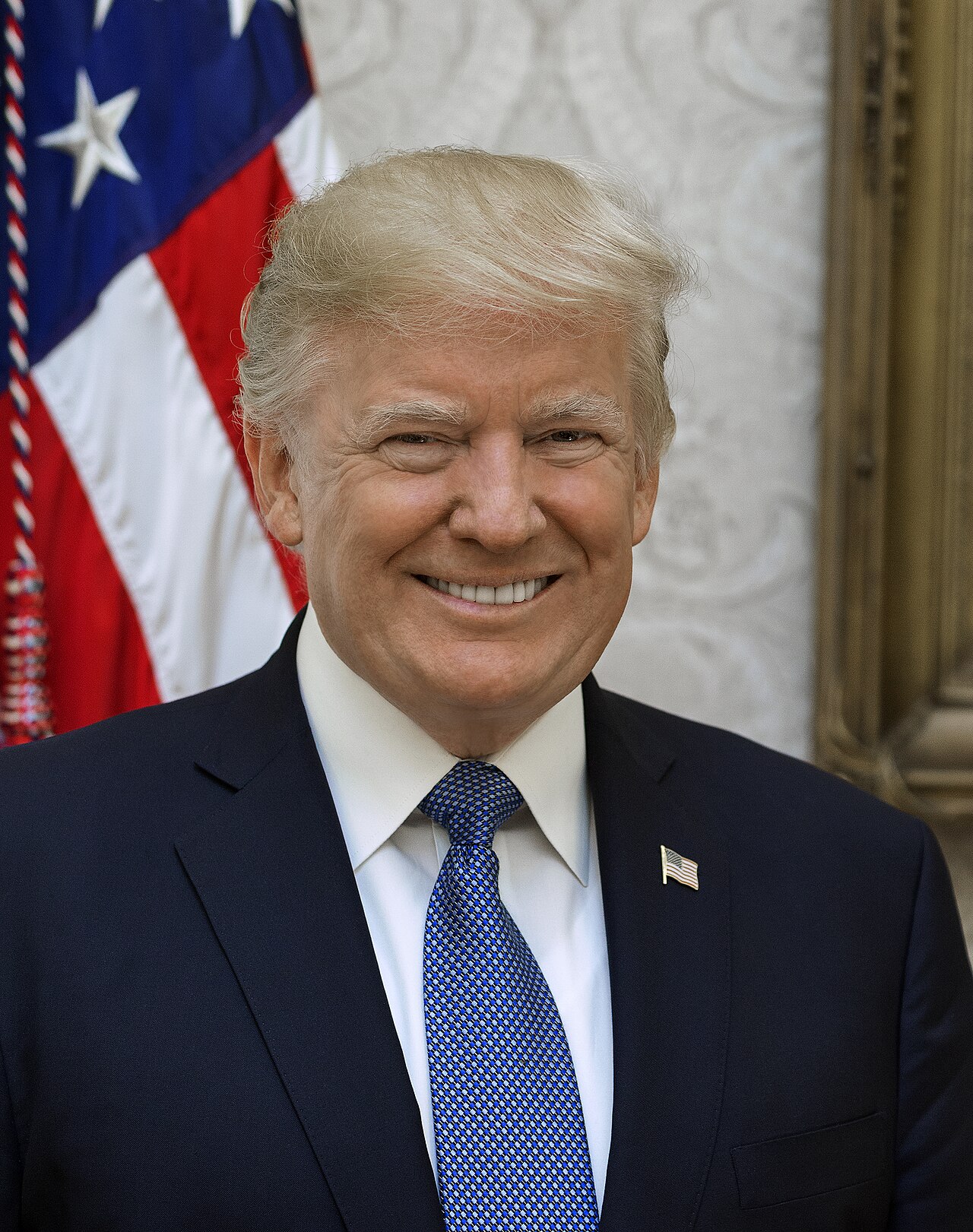
Donald Trump, official White House portrait. Trump appointed Alexander Acosta — the prosecutor who negotiated Epstein's 2007 immunity agreement — as Secretary of Labor in 2017, after Acosta told the transition team Epstein "belonged to intelligence."
The Acosta Deal
In 2017, Trump appointed the prosecutor who gave Epstein immunity — after that prosecutor told the transition team Epstein "belonged to intelligence." In 2025, the same administration weaponized the files as opposition research while the FBI's own review found no predicate to investigate anyone.
On June 30, 2007, Alexander Acosta — then the United States Attorney for the Southern District of Florida — signed a Non-Prosecution Agreement granting Jeffrey Epstein immunity from federal prosecution. The agreement extended blanket immunity to unnamed co-conspirators. Victims were not told it existed.1
Epstein served thirteen months in a county jail, was permitted to leave for work release six days a week, and was never charged with a federal offense.
Nine years later, Donald Trump became the 45th President of the United States.
What Acosta Agreed To
The Office of Professional Responsibility reviewed the 2007 agreement and documented what it found. Acosta had ended the federal investigation before significant investigative steps were completed. He had agreed to terms OPR described, in a formal finding, as "unusual and problematic." The Crime Victims' Rights Act required that victims be notified of the agreement. They were not.1
"Acosta's application of federalism principles was too expansive, his view of the strength of the evidence was too limited, and he agreed to several unusual and problematic terms in the NPA without the consideration required under the circumstances."1
The agreement covered Epstein's co-conspirators by name — names that were sealed. No federal charges were brought against any of them. The NPA resolved a federal investigation into what prosecutors had documented as a multi-year pattern of systematic child sex trafficking.

"Belonged to Intelligence"
In early 2017, Trump's transition team conducted vetting interviews for Cabinet nominees. Acosta was Trump's pick for Secretary of Labor. The transition team asked Acosta directly whether the Epstein case might create a confirmation problem.
Acosta's answer was documented in an internal SDNY email forwarding a Daily Beast news article, dated July 10, 2019.2
"Acosta had explained, breezily, apparently, that back in the day he'd had just one meeting on the Epstein case. He'd cut the non-prosecution deal with one of Epstein's attorneys because he had 'been told' to back off, that Epstein was above his pay grade. 'I was told Epstein belonged to intelligence and to leave it alone,' he told his interviewers in the Trump transition, who evidently thought that was a sufficient answer and went ahead and hired Acosta."2
The transition team accepted this explanation. The Labor Department declined to comment when the article was published.2
Acosta was confirmed as Secretary of Labor on April 27, 2017, by a vote of 60-38.
The Trust Attorney
On August 8, 2019 — two days after Epstein's arrest in the Southern District of New York — Epstein signed a new will. The will named Kathryn Ruemmler, the former White House Counsel to President Obama, as successor executor of his estate.3
Ruemmler's connection to Epstein's legal instruments predated the arrest. Epstein's 2017 Trust, executed two years before he died, named Ruemmler as successor trustee under Section 7.1: "In the event a Trustee resigns, is removed, becomes incapacitated or is unwilling or is unable to serve, KATHRYN RUEMMLER shall be appointed the successor trustee."3
The 2017 Trust controlled the principal financial structure of what became a $577 million estate.
In October 2014, Epstein sent Ruemmler a series of emails coaching her on how to prepare for a potential Attorney General nomination. He told her to hire a video coach, to practice hand movement and head tilting, and to "get the right glasses." He gave her a two-month preparation timeline.4
"I have some concrete suggestions for moving forward. 1) Let's hire a video coach. You need to be trained. Samantha is terrible. No hand movement or head tilting or nodding. Blinking. You will need to get the right glasses. You have two months from today."4
Ruemmler was not appointed Attorney General. She became a partner at Latham & Watkins, then Goldman Sachs's general counsel. Her position as successor trustee and executor of Epstein's estate — established through legal instruments executed after Epstein's 2008 conviction — was not publicly known until the documents were released.
Thirteen Days
Jeffrey Epstein was arrested at Teterboro Airport on July 6, 2019.
Acosta held a press conference on July 10, defending the 2007 agreement and citing the intelligence claim. Calls for his resignation were immediate. The child advocacy organization ECPAT-USA sent a letter to the White House the same week demanding his removal, citing his role in shielding Epstein from federal charges.5
Alexander Acosta resigned on July 19, 2019 — thirteen days after Epstein's arrest.5
The No-Predicate Memo
Epstein died in federal custody on August 10, 2019. The official finding was suicide.
Federal investigation into his network continued through 2025. In July of that year, the FBI completed an internal review. The bureau concluded it had found no predicate to open an investigation against uncharged third parties.6
The finding was reported in the FBI's own daily news briefing on November 17, 2025:
"We did not uncover evidence that could predicate an investigation against uncharged third parties."6
Three months later, in November 2025, Donald Trump publicly demanded that the Justice Department investigate Epstein's ties to his political opponents — naming Bill Clinton, Larry Summers, and Reid Hoffman. Attorney General Pam Bondi, at Trump's direction, ordered the Manhattan U.S. Attorney to open the inquiry.6
None of the individuals Trump identified had been accused of sexual misconduct by Epstein's victims. The same FBI that had just found no predicate for any uncharged-party investigation was now directed to investigate targets selected by the sitting president.
The Institutional Arc
The line from the 2007 NPA to the 2025 Bondi investigation runs through a series of decisions made by the same institution — the executive branch of the United States government.
A federal prosecutor agreed to terms OPR later found "unusual and problematic." The architect of that agreement told a presidential transition team the immunity was ordered by intelligence, and was hired. That president's Attorney General — a decade and a half later, in the same administration's second term — weaponized the document release as opposition research while the FBI's own internal review sat on file concluding there was nothing to investigate.
The agreement Acosta signed in 2007 had a specific operational purpose: to end the federal investigation and prevent prosecution of Epstein's co-conspirators. That purpose was accomplished. The men named in the sealed annexes were never charged.
What the 2007 NPA could not accomplish — and what the 2025 Bondi investigation was designed to provide — was political utility. The files that document Epstein's network now serve, in the hands of the executive that declined to prosecute it, as leverage against the network's political critics.
Open Questions
- Who specifically told Acosta that Epstein "belonged to intelligence" — and through what channel?
- What do the sealed annexes to the 2007 NPA contain, and which co-conspirators are named?
- Did any member of the Trump transition team document or escalate Acosta's "intelligence" claim before or after his confirmation?
- Why did Ruemmler agree to serve as successor trustee and executor of Epstein's estate?
- What instructions, if any, did Trump give to Bondi regarding which names to investigate versus which names to exclude?
- Did the July 2025 FBI "no predicate" finding cover Trump himself, given the active NTOC compilation of 15+ complainants documented the same month?

Get help building custom platforms, AI-powered tools, and data-driven applications for your business or projects.
This article is based on documents released under the Epstein Files Transparency Act (EFTA). All claims are sourced to specific EFTA documents identified by Bates number. Entity tier classifications reflect evidence strength, not legal determinations.
Research and initial drafting assisted by Claude AI (Anthropic). All articles are reviewed, fact-checked, and edited by Derek Emsbach.
Continue Reading
Related investigations

The September Salon
In September 2014, the scheduling apparatus of a convicted sex offender orchestrated meetings at his Manhattan townhouse involving the Deputy Secretary of State (later CIA Director), the Secretary General of the Council of Europe, a former Israeli Prime Minister, a former White House Counsel, a former Treasury Secretary, a billionaire venture capitalist, and a filmmaker accused of child sexual abuse. The EFTA corpus preserves the emails that choreographed it all — including Epstein's request for "alone time" with America's second-highest diplomat.
Let Me Teach You
An FBI Protect Source victim named Donald Trump as her assailant in three recorded interviews. A fourth session was dedicated solely to her account. She declined to proceed, asking “what’s the point?” The FBI then catalogued 15+ additional complainants — and concluded it lacked predicate to investigate.

The White House Counsel
The EFTA corpus documents a seven-year relationship between Kathryn Ruemmler — former White House Counsel to President Obama — and convicted sex offender Jeffrey Epstein. She was named successor trustee of his $577 million trust and successor executor of his will. She dined with Woody Allen and Peter Thiel at his home. She met Bill Gates through his office. She introduced Cass Sunstein to his social circle. And when Bloomberg reported her as the leading candidate for Attorney General, it was Epstein who coached her on video presentation, glasses, and body language.
Curious what Epstein and his network talked about?
A community-built email archive spanning years of private correspondence within the Epstein network.
Explore the Archive →