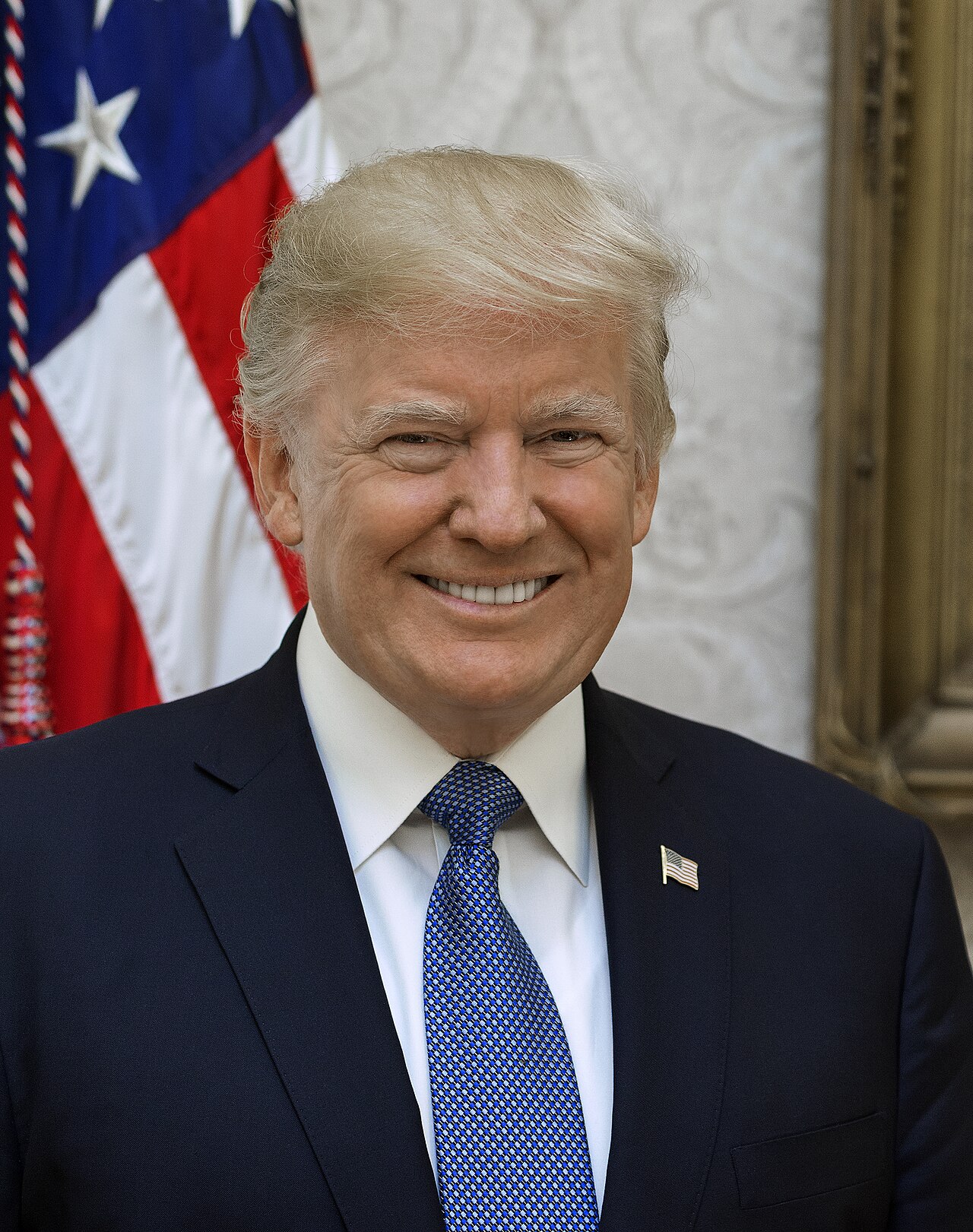
Donald Trump, official White House portrait. Trump is named by a Protect Source victim in three FBI interviews (2019), by a corroborating NTOC complainant (2025), and in a civil complaint by Katie Johnson (2016), dismissed after the plaintiff reported threats.
Let Me Teach You
An FBI Protect Source victim named Donald Trump as her assailant in three recorded interviews. A fourth session was dedicated solely to her account. She declined to proceed, asking “what’s the point?” The FBI then catalogued 15+ additional complainants — and concluded it lacked predicate to investigate.
She was between 13 and 15 years old. Jeffrey Epstein drove or flew her from the island to either New York or New Jersey. She was, she later told the FBI, "introduced to someone with money, money... It was Donald Trump." They were in a very tall building with huge rooms. Everyone else left when Trump asked them to.1
"Let Me Teach You"
Donald Trump mentioned something to the effect of, "Let me teach you how little girls are supposed to be."1
He unzipped his pants and put her head down.
She bit him.
"Get this little bitch the hell out of here."1
Trump struck her. People reentered the room. A blonde woman approached her at some point that day and said, "let me give you a tip little girl about your breasts, wear a bra every night." Those words stayed with her throughout the years.1
The victim told FBI agents she bit Trump because he disgusted her. "He had money, it reeked off of him."1
She had two additional interactions with Trump. She asked the interview to move on to a different subject.1
These words — and their context — are drawn from a federal law enforcement document: FD-302 3501.045-003, dated August 7, 2019. The victim is identified only as a Protect Source. She is not named in this story.
What She Overheard
The victim's account did not end with the assault. She told agents what she heard in that building — in rooms where Epstein and Trump spoke in front of her.
TRUMP and EPSTEIN sometimes used the terms "fresh meat", "untainted" and "not jaded" while referring to girls.1
She heard Trump and Epstein discussing blackmail. She was confident Trump knew Epstein blackmailed people because she heard them talking about it. She also heard Trump discussing illegal building permits and "washing money through casinos."1
She said she got the feeling the relationship between Epstein and Trump included jealousy. She thought Trump appeared jealous of Epstein — but that at some point, "they ended up on level playing fields."1
Interview Three: The Clarification
Three weeks after the second interview, agents met with the victim again. The session was recorded as FD-302 3501.045-005, dated August 20, 2019.2
Agents asked for additional details about her first interaction with Trump. She clarified: when she previously said Trump struck her after she bit him, she had more to add. He had "pulled [her] hair and punched [her] on the side of [her] head."2
In the same session, agents asked how many threatening calls she had received over the years. She could not provide a count. There were numerous calls throughout her life. They were "regular" at first, then sporadic. In the preceding four years, the threats had increased "a little."
She stated under her breath that if it was not EPSTEIN, maybe it was the "other one". When asked the identity of the "other one", II stated, "Trump."2
Immediately after, she looked at her attorney and said, "when he was running..." Her attorney completed the thought: "more tracks to cover." The victim repeated it back.2
The threatening calls spanned decades. One or two incidents where cars tried to run her off the road occurred before a certain date; another happened approximately two years prior to the interview. One incident involved Interstate 5 near Oregon — dark, rainy, two vehicles described as "nice, and black or blue" attempting to force her off the road, an 18-wheeler ahead.2
She did not call the police. She never wrecked.
Interview Four: The Fourth Session
On October 16, 2019, FBI agents met with the victim for a fourth time.3
This session was different. Before any questions, agents explained the purpose: they wanted to keep the fourth interview focused on abuse she endured at the hands of individuals associated with Jeffrey Epstein. They reminded her that she had previously mentioned sexual contact with — and the FD-302 uses the parenthetical — "(current U.S. President) DONALD TRUMP" while she was a minor.3
She asked agents, "what's the point?"3
She was aware the statutes of limitation may have run on any viable federal violation. She asked the question twice. Agents told her that all victims of crime should have the opportunity to tell their story. They wanted to provide her with that opportunity should she choose to accept it.
She went home to think about it.
The FD-302 ends there.3
The Pattern: Three Independent Sources
The victim's account is a single direct source. The FBI cannot build a case on one unrecorded interview where the witness declines to proceed. But the account does not exist in isolation.
In August 2025, the FBI's National Threat Operations Center compiled a list of complaints naming Trump in connection with sexual assault.4 The NTOC document — an internal email thread — catalogues the summaries. One entry stands out.
[Complainant] reported an unidentified female friend [who was] forced to perform oral sex on President Trump approximately 35 years ago in NJ. The friend told [complainant] that she was approximately 13-14 years old when this occurred, and the friend allegedly bit President Trump while performing oral sex. The friend was allegedly hit in the face after she laughed about biting President Trump. The friend said she was also abused by Epstein.4
The Washington Field Office was dispatched to conduct an interview.4
The behavioral sequence — forced oral sex, victim bites, Trump strikes — appears in two separate FBI records, collected six years apart, from sources who had no documented contact with each other.
A third source exists outside the EFTA corpus. In September 2016, a plaintiff identified as "Katie Johnson" filed a civil complaint in the Southern District of New York (Case 1:16-cv-07673). The complaint alleged that Trump forcibly raped her when she was 13 years old at Epstein's Manhattan residence at 9 East 71st Street during the summer of 1994. A separate declarant, identified as "Tiffany Doe," submitted a sworn statement saying she witnessed four sexual encounters between Trump and the plaintiff. The case was voluntarily dismissed on November 4, 2016, after the plaintiff reported receiving threats.
The three accounts span 13 years, three states, and three independent reporting channels:
| Source | Approximate Year | Age | Location | Pattern |
|---|---|---|---|---|
| 3501.045 victim (FBI FD-302) | ~1981–1984 | 13–15 | NYC/NJ high-rise | Forced oral sex, victim bites, Trump pulls hair, punches head |
| NTOC Complainant 1 (FBI compilation) | ~1990 | 13–14 | New Jersey | Friend forced oral sex on Trump, friend bites, Trump hits face |
| Katie Johnson (civil complaint, SDNY) | Summer 1994 | 13 | Epstein's NYC mansion | Forcible rape, plaintiff pleads, Trump strikes face with open hand |

The Institutional Conclusion
In July 2025, the FBI produced an internal memorandum. Its key line was reported in an FBI Daily News Briefing dated November 17, 2025:
"We did not uncover evidence that could predicate an investigation against uncharged third parties."5
The memo was cited publicly by Trump himself in November 2025, after he called on the Department of Justice and FBI to investigate Epstein's ties to his political opponents. Attorney General Pam Bondi ordered Manhattan U.S. Attorney Jay Clayton to investigate Epstein's connections to Bill Clinton, Larry Summers, and Reid Hoffman.5
None of those individuals had been named by Epstein victims in the FBI's records.
Donald Trump had been.
Open Questions
- What did the Washington Field Office determine after interviewing the NTOC Complainant 1's source? The NTOC document shows WFO was dispatched but does not record the outcome.
- What are the two additional interactions the 3501.045 victim declined to describe? They were not recorded and appear to be permanently unrecorded.
- Were the threatening phone calls the victim received ever traced? The FD-302 records the calls in detail but no investigative follow-up is documented in the released files.
- Who is "Jim Atkins" (phonetic), identified in the victim's account as co-blackmailer of her mother alongside Epstein?
- Why did the July 2025 "no predicate" memo reach its conclusion while the FBI simultaneously held a compilation of 15+ complainants naming Trump? What evidentiary standard was applied?
- Did the Katie Johnson plaintiff's attorney communicate with the FBI before the November 2016 dismissal?

Get help building custom platforms, AI-powered tools, and data-driven applications for your business or projects.
This article is based on documents released under the Epstein Files Transparency Act (EFTA). All claims are sourced to specific EFTA documents identified by Bates number. Entity tier classifications reflect evidence strength, not legal determinations.
Research and initial drafting assisted by Claude AI (Anthropic). All articles are reviewed, fact-checked, and edited by Derek Emsbach.
Continue Reading
Related investigations

The Mar-a-Lago Connection
Fourteen phone numbers. Message pads showing calls during the abuse period. A flight on Epstein’s plane. A 15-year-old recruited from the spa. A sworn affidavit laying out seven grounds for deposition. The documented relationship between Donald Trump and Jeffrey Epstein, told entirely through civil litigation records.

Normal for This Client
Deutsche Bank opened 76 accounts for a convicted sex offender, processed millions in payments to "ostensible foreign models" and co-conspirators, watched his attorney structure cash withdrawals — and when compliance flagged a wire to a Russian woman, the analyst wrote: "Once this type of activity is normal for this client it is not deemed suspicious."

The Conveyor Belt
In 1988, CBS 60 Minutes exposed Jean-Luc Brunel as a serial predator in the modeling industry. Sixteen years later, Jeffrey Epstein wired him $1 million to start MC2 Model Management — a modeling agency his own business partner confirmed to the FBI was a "transport agency of underage girls." Brunel operated for thirty-two years after the first public exposure. He was finally arrested — by French police, not American ones — in December 2020. He was found dead in his prison cell two months later.
Curious what Epstein and his network talked about?
A community-built email archive spanning years of private correspondence within the Epstein network.
Explore the Archive →